Darwin's Apple: The Evolutionary Biology of Religion by Mitchell Diamond
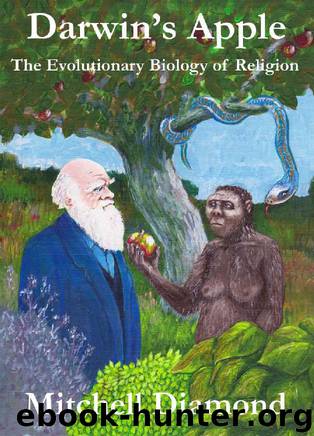
Author:Mitchell Diamond [Diamond, Mitchell]
Language: eng
Format: epub, mobi
Publisher: Purple Hills Books
Published: 2013-08-31T04:00:00+00:00
Different neural pathways are responsible for perception, recognition (memory), and emotional responses to music, Peretz says. “Severe deficits in perception and memorization of music can leave emotional judgments of music unimpaired. Such a spectacular isolation of emotional judgments of music suggests the presence of an emotional neural pathway for music.” (p. 106) The development of these pathways are encoded in the human genome. Learning or conditioning can modify the strength of these pathways but not their origination, which form under genetic directives.
Researchers ask whether the emotions stimulated by music are qualitatively the same as emotions generated by other perceptions and behaviors. Music, it turns out, excites the very same emotional brain regions as other sources of emotion. Brain scans show emotional responses to music cause changes in limbic and paralimbic areas, both of which modulate emotions, as well as in the neocortex for both dissonance (music evoking negative feelings) and consonance (music evoking positive feelings). However, dissonance triggers somewhat different limbic areas compared to consonance. (Brown, 2003, p. 2033; Blood, et al., 1999, pp. 382-3) These activations occur whether the music is familiar or unfamiliar. From an emotional point of view, prior association of musical memory is not required to elicit an affective reaction for either positively or negatively perceived music. This helps explain why disparate cultures can recognize the mood in music despite not being familiar with it. Peretz says, “There is a distinct emotional pathway for music processing, and that this neural pathway may differ according to the emotion considered.” (Peretz, 2001, p. 105)
The researchers also found that positive emotional response was buoyed by decreased activity in brain regions associated with negative emotions. The different emotions generated by different musical forms excite emotion-specific pathways. This indicates that there are separate pathways for music recognition versus emotional judging of the music and even the style of music—whether the music is sad, scary, or happy. This is confirmed by the tragic yet elucidating studies of brain-damaged individuals.
There is clear evidence that specific emotions can be lost after brain damage. This is the case for the recognition of “scary”, and to some extent, “sad”, music after damage to the amygdala, and of the preference for consonance over dissonance after lesion to the parahippocampal gyrus. (p. 105)
Download
Darwin's Apple: The Evolutionary Biology of Religion by Mitchell Diamond.mobi
This site does not store any files on its server. We only index and link to content provided by other sites. Please contact the content providers to delete copyright contents if any and email us, we'll remove relevant links or contents immediately.
The Lost Art of Listening by Michael P. Nichols(7509)
Why I Am Not A Calvinist by Dr. Peter S. Ruckman(4157)
The Rosicrucians by Christopher McIntosh(3523)
Wicca: a guide for the solitary practitioner by Scott Cunningham(3182)
Signature in the Cell: DNA and the Evidence for Intelligent Design by Stephen C. Meyer(3141)
Real Sex by Lauren F. Winner(3026)
The Holy Spirit by Billy Graham(2957)
To Light a Sacred Flame by Silver RavenWolf(2828)
The End of Faith by Sam Harris(2747)
The Gnostic Gospels by Pagels Elaine(2537)
Waking Up by Sam Harris(2464)
Nine Parts of Desire by Geraldine Brooks(2375)
Jesus by Paul Johnson(2366)
Devil, The by Almond Philip C(2338)
The God delusion by Richard Dawkins(2314)
Heavens on Earth by Michael Shermer(2286)
Kundalini by Gopi Krishna(2188)
Chosen by God by R. C. Sproul(2166)
The Nature of Consciousness by Rupert Spira(2110)
